Why High Liquidity Pool TVL Can Still Mean a Poor Sell Quote
A token balance worth $5,000 at the spot price may sell for much less. See why liquidity pool TVL, trading depth and price impact tell different stories about what you can receive.
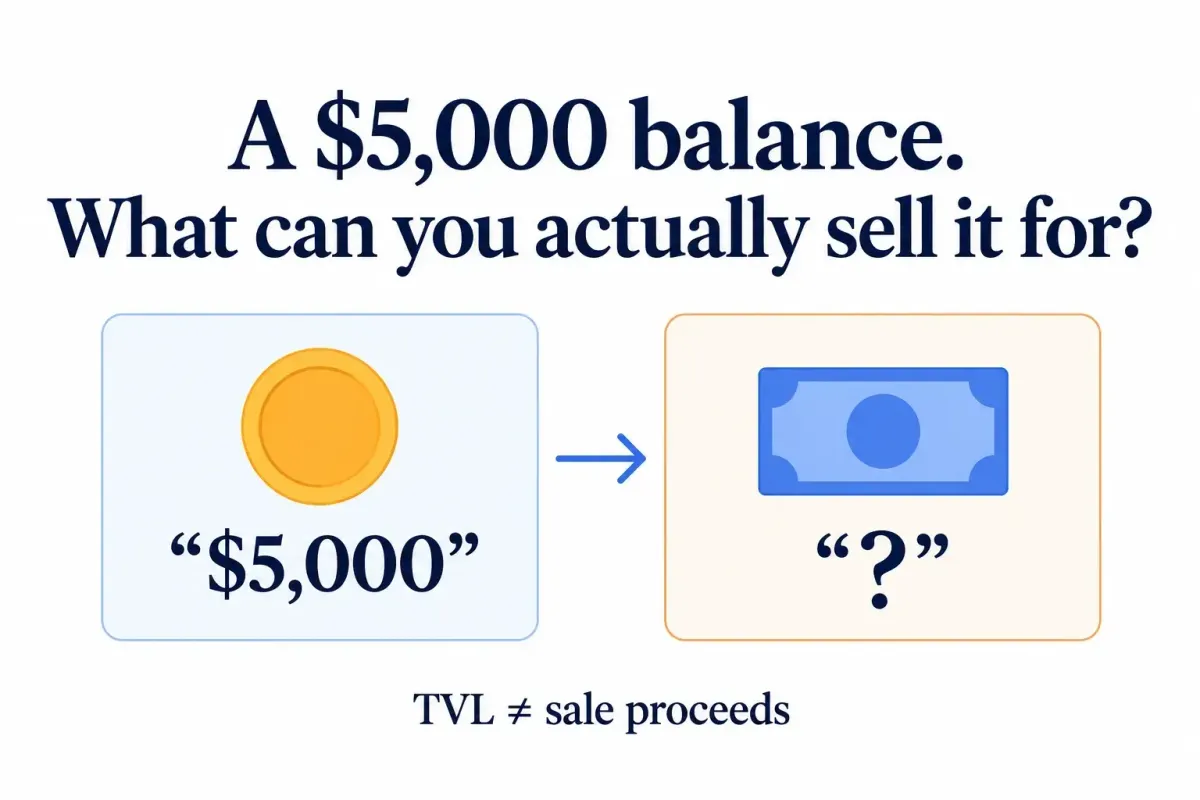
A liquidity pool can show $100,000 in total value locked while a token balance worth $5,000 at the spot price sells for considerably less. TVL measures the marked value of pool assets; trading depth determines how far your order moves the price.
This matters both when assessing a token’s liquidity and when deciding how much capital to put into its pool. An opening price and a TVL figure do not tell you what a meaningful sell order will return.
Half the displayed value may be the token being sold
Consider a hypothetical constant-product pool holding 500,000 tokens and 50,000 USDC. At an initial reserve-ratio price of $0.10 per token, with USDC valued at $1, its TVL is $100,000.
That is not $100,000 of USDC waiting to buy tokens. The other half is the token’s marked value. Selling adds more tokens to the pool and removes USDC, changing the price along the way.
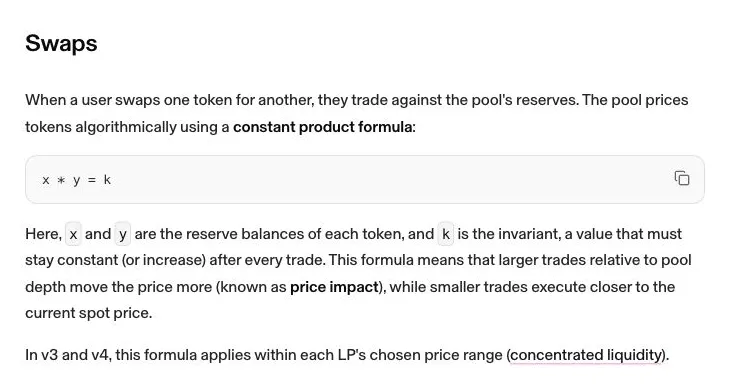
Uniswap’s AMM documentation explains the constant-product relationship, x × y = k: larger trades relative to reserves cause greater price impact. The example below excludes fees, arbitrage, transfer taxes and other trading routes to isolate that mechanism.
A $5,000 spot valuation can produce about $4,545 in proceeds
Sell 50,000 tokens into that pool. The token reserve rises to 550,000. To preserve the reserve product, the remaining USDC balance becomes approximately 45,454.55.
The seller therefore receives 4,545.45 USDC before fees, about 9.1% below the $5,000 spot valuation. The average execution price is about $0.0909 per token. The pool’s post-trade spot price is about $0.0826; it is not the average price received across the order.
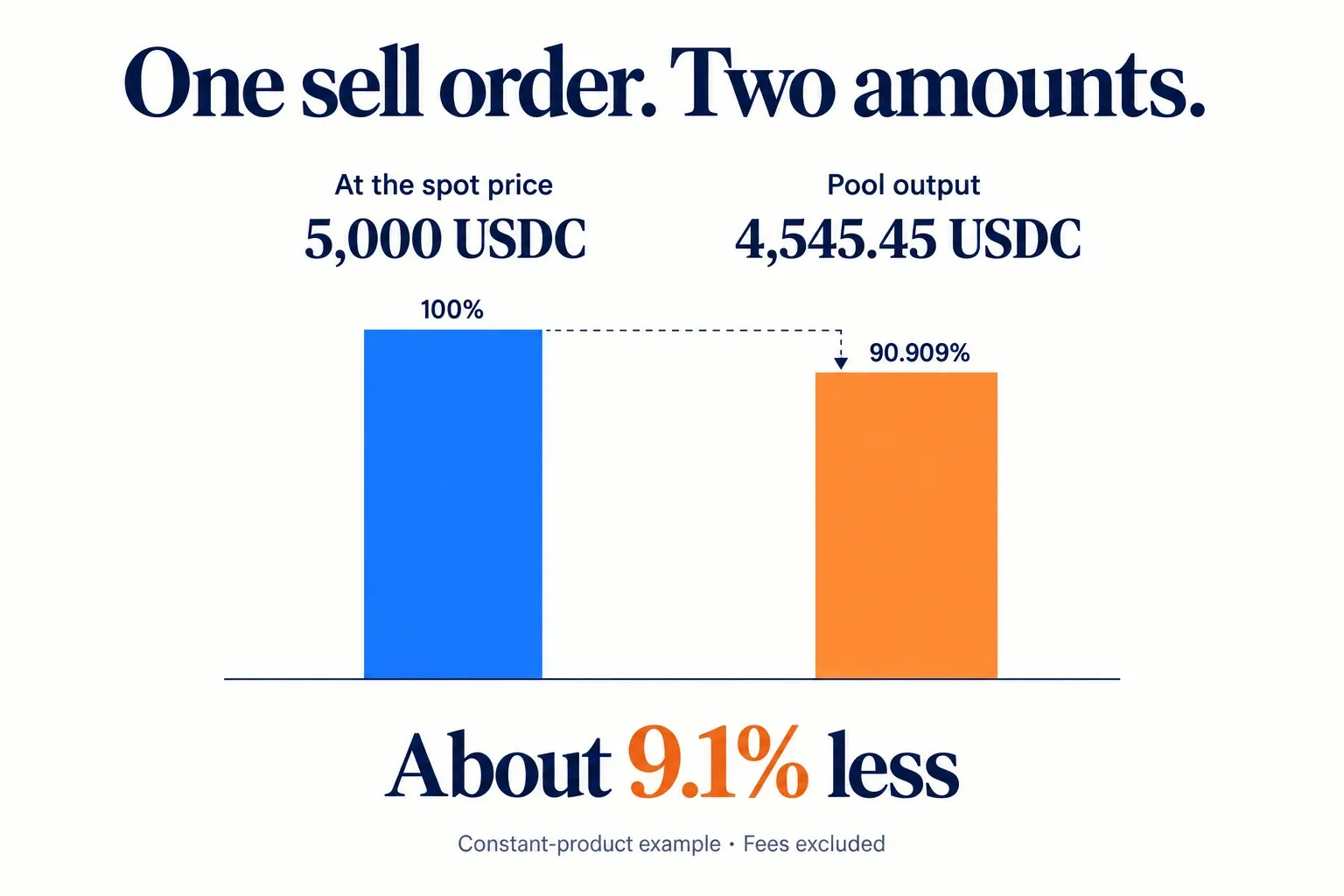
Hypothetical constant-product calculation. Fees, arbitrage, transfer taxes and other routes are excluded.
The lower proceeds are already part of the pool quote. They are not necessarily a failed transaction or unexpected slippage after you submit it.
The opening price and the liquidity budget do different jobs
Keep the opening price unchanged but double both reserves:
| Initial pool | Initial TVL | Proceeds from selling 50,000 tokens |
|---|---|---|
| 500,000 tokens + 50,000 USDC | $100,000 | About 4,545.45 USDC |
| 1,000,000 tokens + 100,000 USDC | $200,000 | About 4,761.90 USDC |
Both start at $0.10. The larger pool gives a better quote for the same order because the order is smaller relative to its reserves. The same simplifying assumptions apply to both rows.
For a team preparing a Solana market, this is the distinction to understand before choosing deposit amounts. The SlerfTools liquidity-creation documentation distinguishes the base token from the quote token, commonly SOL or USDC. For the constant-product model used here, their ratio determines the initial price; their scale determines how much that price moves under a given order.
The Docs cover the operating steps. The decision here is whether the proposed reserves can support the order sizes you expect. Creating a pool through a tool does not itself guarantee adequate liquidity.
Concentrated liquidity makes TVL an even less complete answer
Total reserves alone are not enough for a concentrated-liquidity pool. Capital is allocated to specific price ranges, so two pools with similar TVL can quote the same order differently.
In its concentrated-liquidity documentation, Uniswap explains that a position becomes inactive when the price leaves its range and becomes active again if the price returns. Assets outside the active range can remain part of pool value without supplying liquidity at the current price.
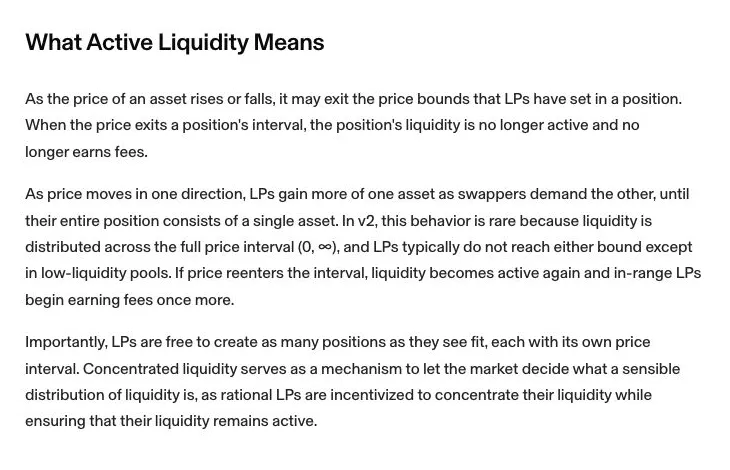
The full-reserve calculation above therefore should not be applied directly to every CLMM pool. Use the quote for the actual pool and route, including the ranges the order would cross.
Raising slippage tolerance does not improve the quote
Price impact is the effect of the order on execution prices. Slippage tolerance sets how far execution may deviate from the expected quote before the transaction fails, subject to the interface’s rules.
If the quote is 4,545 USDC, allowing more slippage does not turn it into 5,000 USDC. It permits a lower minimum acceptable output. For an exact-input sell, compare the expected proceeds, estimated price impact, fees and minimum output separately.
Also check whether the quote uses one pool or several routes. Adding their TVLs together does not mean an order can access all their assets at one price. Splitting the order is not an automatic fix either: without intervening changes to the pools, splitting trades along the same curve does not create more depth.
For a holder, test the size you actually want to sell. For a team, test plausible order sizes against the proposed reserves. TVL supplies context; the quote answers what the transaction could return at that moment.
About SlerfTools
SlerfTools is a multi-chain Web3 toolkit supporting Solana, BNB Chain (BSC), Base, Ethereum, Robinhood Chain, and other supported EVM-compatible networks. It provides tools for common on-chain workflows, including token management, liquidity management, wallet operations, batch transfers, and batch transaction execution. SlerfTools is designed to help teams work more efficiently while retaining control of wallet access and transaction approvals.