How Much Initial Liquidity Do You Need on PancakeSwap?
Planning a PancakeSwap launch? Estimate initial liquidity from expected trade sizes, then account for paired tokens, fees and pool type.

For a new token launch on BNB Chain, the useful starting point is the size of the trades your pool needs to handle. A pool funded for 0.1 BNB orders can behave very differently when someone spends 1 BNB.
In a simplified PancakeSwap V2 model, a 1 BNB buy needs 19 BNB on the BNB side of the pool to receive only 5% fewer tokens than the starting price suggests. You also need the matching project tokens. This is a planning example before fees—not a PancakeSwap minimum or a recommended risk limit.
What are PancakeSwap's initial liquidity requirements?
Separate two questions: what lets you create a pool, and what gives it enough liquidity for expected trades. Meeting the first does not answer the second.
For a new V2 pair, you supply both assets, such as your token and BNB. Their ratio sets the initial price; their amounts determine how strongly trades affect execution. Gas and any service fees are separate costs.
Advice such as “start with 5 BNB” is incomplete unless it explains the expected order size. A 2021 OpenZeppelin community discussion offers fixed BNB amounts, but the respondent explicitly labels them as opinions. They are not official PancakeSwap requirements.
How much BNB should you put in the initial pool?
Choose an expected buy size and compare its token output with what it would buy at the pre-trade price.
For this example, suppose you want the buyer to receive no more than 5% fewer tokens. Under the V2 constant-product model, ignoring fees and token taxes, the starting BNB reserve needs to be 19 times the purchase amount.
| Expected single buy | Starting BNB reserve for this example | Project-token deposit |
|---|---|---|
| 0.1 BNB | 1.9 BNB | Tokens worth 1.9 BNB at the chosen starting price |
| 1 BNB | 19 BNB | Tokens worth 19 BNB at the chosen starting price |
| 2 BNB | 38 BNB | Tokens worth 38 BNB at the chosen starting price |
Each row describes a separate pool at its starting state. The 5% figure is an illustrative output difference, not a suggested slippage setting or a forecast of the price after the trade.
For the middle row, an initial price of 0.00001 BNB per token requires 1.9 million tokens alongside 19 BNB. The two sides have a combined initial quoted value of 38 BNB. That does not mean depositing 38 BNB in cash, nor does it mean the project tokens could all be sold at that price.
What can make the real liquidity budget larger?
Fees and token taxes. PancakeSwap's documentation lists a 0.25% V2 trading fee. Once fees are included, the 19 BNB example delivers slightly fewer tokens than the table's target. Transfer taxes can reduce output further.
Larger orders and selling. Check a larger buy and a plausible early holder's sale, not just the average purchase. An airdrop recipient may sell far more tokens than a typical buyer purchases. Several orders in sequence also change the reserves; the table cannot be reused unchanged after each trade.
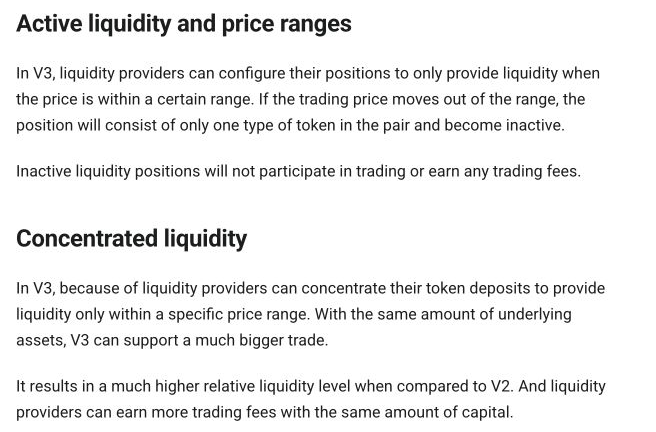
Pool type. V3 concentrates liquidity within a chosen price range. The same total deposit can support different trade sizes depending on that range, and a position outside its range becomes inactive. Do not use the V2 table to budget a V3 position.
If the required reserve exceeds the available budget, reduce the planned launch scale or revise the execution target. Raising slippage tolerance does not fund the pool.
Turn the budget into actual deposit amounts
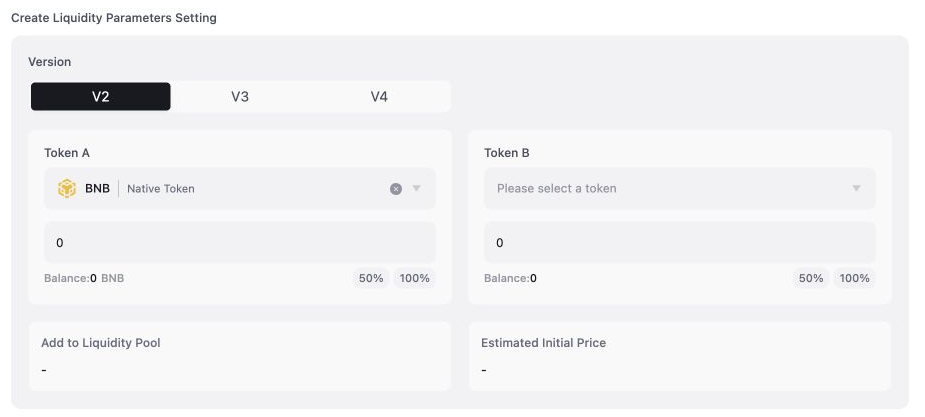
Before creating the pair, settle the quote asset, expected order sizes, pool version, and both deposit amounts. Keep enough BNB outside the pool for gas and any applicable service fee.
With those decisions made, the SlerfTools BSC Create Liquidity Pool page lets you select PancakeSwap and the pool version, enter both asset amounts, and review the estimated initial price. It is the execution step after budgeting; it does not decide whether your reserves are sufficient.
The practical test is straightforward: can your budget support the trades you expect, at an execution cost you have deliberately chosen? A successful pool-creation transaction alone cannot tell you that.
Calculation note
For a fee-free V2 pool with B BNB and X tokens, a buy of q BNB returns X × q ÷ (B + q) tokens. Compared with X × q ÷ B tokens at the unchanged starting price, the output shortfall is q ÷ (B + q). Setting that to 5% gives B = 19q. These are hypothetical, single-pool calculations, excluding fees, transfer taxes and alternative routes.
About SlerfTools
SlerfTools is a multi-chain Web3 toolkit supporting Solana, BNB Chain (BSC), Base, Ethereum, Robinhood Chain, and other supported EVM-compatible networks. It provides tools for common on-chain workflows, including token management, liquidity management, wallet operations, batch transfers, and batch transaction execution. SlerfTools is designed to help teams work more efficiently while retaining control of wallet access and transaction approvals.