What Is FDV in Crypto? What Fully Diluted Valuation Actually Measures
Understand FDV, circulating market cap and supply risk. Learn why token unlocks and Solana mint authority matter when comparing crypto valuations.

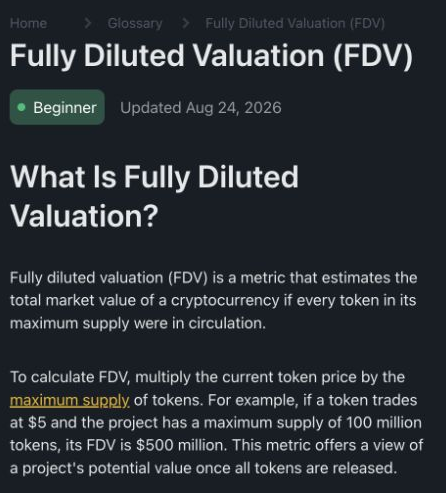
What is FDV in crypto? FDV, short for fully diluted valuation, is the value a token would imply if the supply used in the calculation were priced at today’s market price.
FDV = token price × fully diluted supply
That formula is simple. The difficult part is deciding what “fully diluted supply” includes. It may include tokens that are locked, scheduled to unlock, held by a treasury, or still possible to mint. FDV is therefore a supply-based valuation estimate, not the amount of money invested in a project.
Market cap and FDV use different supply figures
Market cap normally uses circulating supply. FDV uses a larger supply figure, such as a stated maximum supply or a data provider’s estimate of the eventual supply.
Suppose a token trades at $0.10 and 100 million tokens are circulating:
- circulating market cap: $10 million;
- fully diluted supply: 1 billion tokens;
- FDV at the same price: $100 million.
The $90 million gap is not $90 million sitting in a treasury or waiting in a liquidity pool. It is the value implied by the other 900 million tokens if they could all be valued at $0.10. Whether those tokens are locked, scheduled for release, held by insiders, or not yet created changes the risk behind the number.
The useful question is not “Is the FDV high?” It is: Which supply did this FDV use, and how likely is that supply to reach the market?
Why mint authority matters to an FDV check
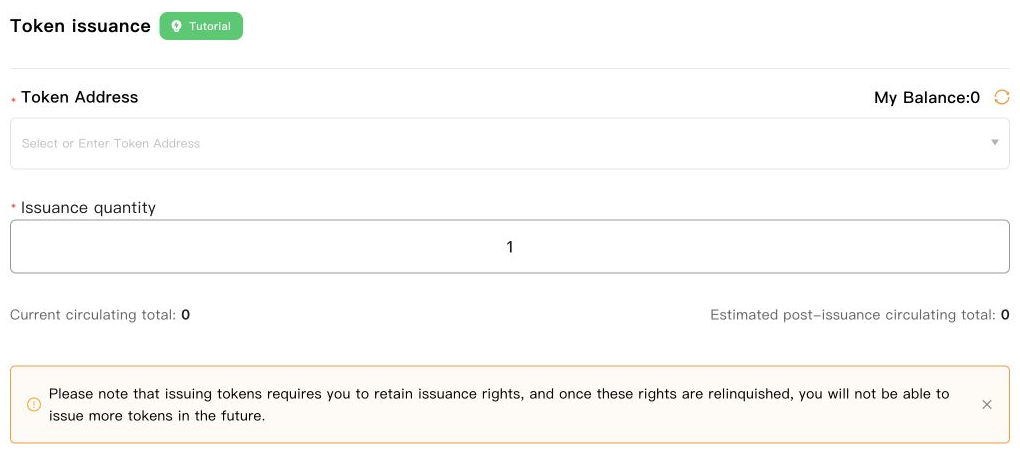
On Solana, mint authority is the permission that can create additional units of a token. If the authority is still active, the current supply may not be the final supply. A project may have a valid reason to mint more tokens for incentives, treasury distribution, or ecosystem growth, but the possibility still matters when you assess dilution.
For example, if the price stays at $0.10 while supply grows from 100 million to 150 million, the supply-based valuation rises from $10 million to $15 million. If demand does not grow with the new tokens, the additional supply can add selling pressure. This example does not predict the price; it shows why the supply rule belongs next to the FDV figure.
Unlocks and minting are separate risks:
- an unlock schedule describes when existing tokens may become transferable;
- mint authority describes whether the total supply can increase under the token’s current rules.
A price page can show one FDV number without making either risk obvious. Check both before comparing tokens.
Revoking authority removes one supply risk
When mint authority is permanently revoked on-chain, that permission can no longer be used to expand the supply. The supply rule becomes easier to verify, and one source of dilution is removed.
It does not create demand, add liquidity, guarantee a fair price, or stop unlocked holders from selling. It is evidence about what the token can do under its current on-chain permissions, not a promise about what the market will do next.
If you need to inspect or execute a Solana token-mint action, see the SlerfTools Token Mint page. If the decision is to remove a supported authority, the SlerfTools Revoke Authority page is the relevant execution entry point. These pages help with the on-chain workflow; they do not decide whether a project should mint or revoke an authority.

A five-minute FDV check
Before comparing two tokens, write down:
- the current on-chain supply;
- the circulating-supply definition used by the data source;
- the supply included in the FDV calculation;
- the current mint-authority status;
- unlock, treasury, team-wallet, and investor information.
Record the date as well. Supply figures, authority states, and unlock schedules can change, and different data providers can use different definitions.
FDV is useful as a valuation scenario: it shows what the stated supply would be worth at the current price. It does not tell you whether the token will rise, whether the project has equivalent cash, or how much a large holder can sell without moving the market.
Sources and assumptions
The supply terms follow CoinMarketCap’s supply definitions. The authority discussion refers to Solana’s mint-authority model; a specific token’s state must be checked on-chain at the time of review. The numerical examples are hypothetical and ignore fees, market impact, and future demand.
About SlerfTools
SlerfTools is a multi-chain Web3 toolkit supporting Solana, BNB Chain (BSC), Base, Ethereum, Robinhood Chain, and other supported EVM-compatible networks. It provides tools for common on-chain workflows, including token management, liquidity management, wallet operations, batch transfers, and batch transaction execution. SlerfTools is designed to help teams work more efficiently while retaining control of wallet access and transaction approvals.