Why Token Prices Can Fall After Buybacks and Burns
Do token burns increase price? Compare PUMP, STONK, ETH, UNI and PONS to understand buybacks, supply changes and the limits of deflationary narratives.
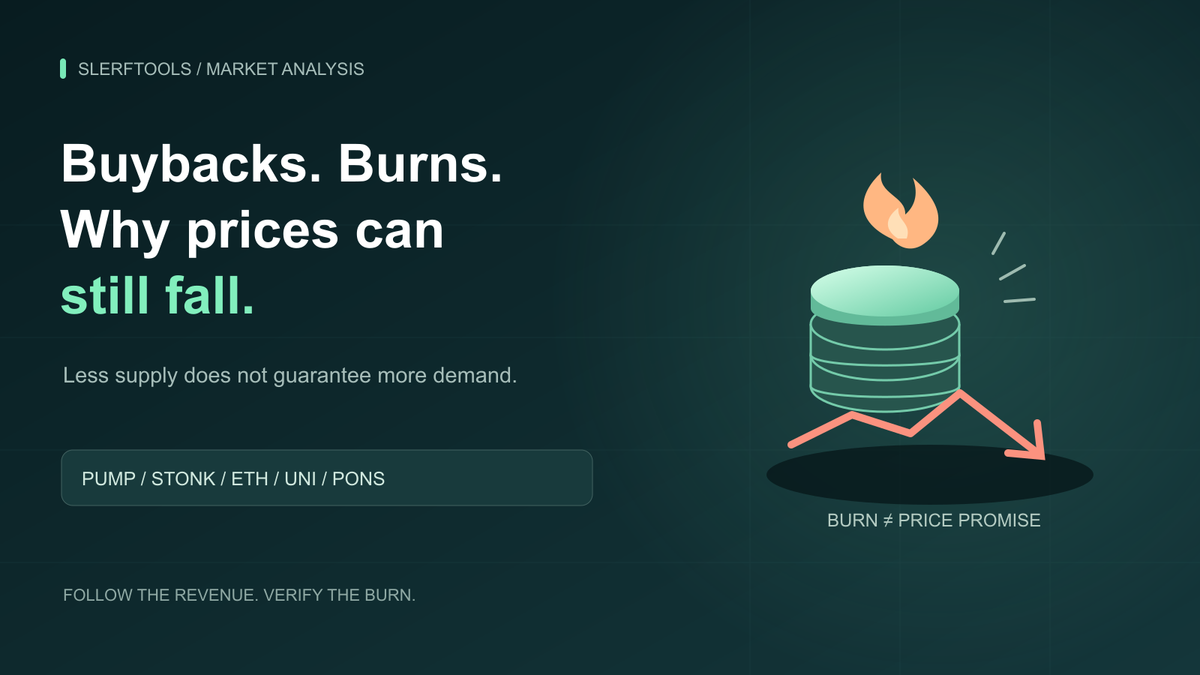
Buybacks, burns and “deflation” are back in crypto market conversations. An announcement often prompts the same question: if a project starts buying back or burning tokens, should the price rise?
The answer depends on what actually happens. A buyback brings tokens back under a project's control. A burn permanently removes tokens from usable supply. Repurchased tokens can also go into a treasury, be locked, or be distributed to stakers. The useful questions are where the money comes from, where the tokens go, and whether supply changes can be verified.
Burning tokens can reduce supply. It does not automatically create demand. Expectations, liquidity, unlocks and new issuance can still push prices lower after a buyback or burn.
A buyback is not the same as a burn
A buyback uses protocol revenue, product revenue or treasury funds to purchase tokens on the market. A burn permanently removes tokens, for example through a burn instruction or an inaccessible address. A project can do both, or either one alone.
Check the funding source, the destination of repurchased tokens, and the transaction records. An announcement screenshot alone does not establish that supply has already fallen.
PUMP: a clear route still does not guarantee a higher price
Pump.fun's PUMP page states that half of every dollar the platform earns buys PUMP on the open market.
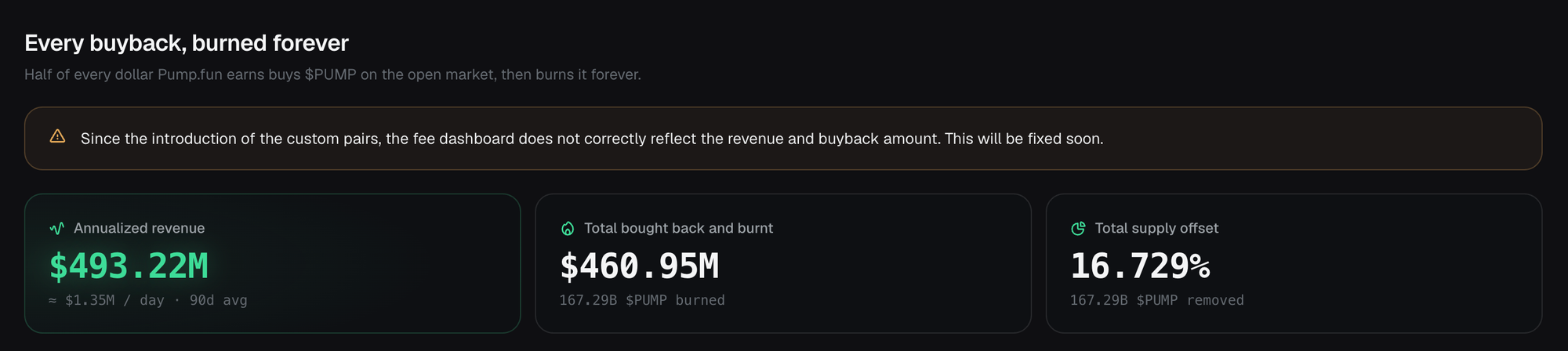
The stated route is straightforward: revenue, purchases and burns each have an explanation. That is a supply-side arrangement, however, rather than a promise that larger buybacks will produce a higher price. Revenue durability and the size of purchases relative to available liquidity still matter.
STONK: burns and new market buying are different measures
StonkFun's Revenue page states that approximately 60% of platform revenue buys STONK on the open market and burns it, with the rest retained. Pricing volatile custom quote tokens can slightly change the measured split. When STONK itself is used as the quote token, it is burned directly, without a market buyback.
The amount burned therefore cannot all be counted as new buying pressure. Nor should one day's burn rate be projected into a fixed schedule for the months ahead. Assessing STONK's deflationary narrative requires platform revenue, actual purchase and burn records, and sustained demand, rather than a price forecast derived from burn totals alone.
ETH: fee burning is not a project buyback
Ethereum's gas documentation explains that the base fee under EIP-1559 is burned. Network usage drives that process; a team does not first spend revenue buying ETH on the market.
ETH burn volume depends on network activity and fee levels. Lower activity can reduce the amount burned. Seeing the word “burn” is not enough to infer a discretionary market purchase or a guaranteed net reduction in supply.
UNI: fee capture depends on the governance and contract path
Uniswap's UNIfication proposal proposed activating protocol fees to support UNI burns, alongside a one-time treasury burn. Its developer documentation describes the TokenJar and Firepit mechanism: fees accumulate in TokenJar, and a caller burns a specified amount of UNI to release the corresponding fee assets.
This links access to collected fees with UNI burning. It differs from the direct market purchase followed by a burn address transfer described for PUMP and PONS. Governance proposals, technical documentation and completed transactions establish different things; a proposed burn is not evidence that every described burn has happened.
PONS: repurchased tokens go to a burn address
The pons Fees and burns documentation states that protocol funds buy PONS and send it to a burn address, permanently reducing circulating supply. The same page explicitly says: “Burning does not guarantee a higher price.”
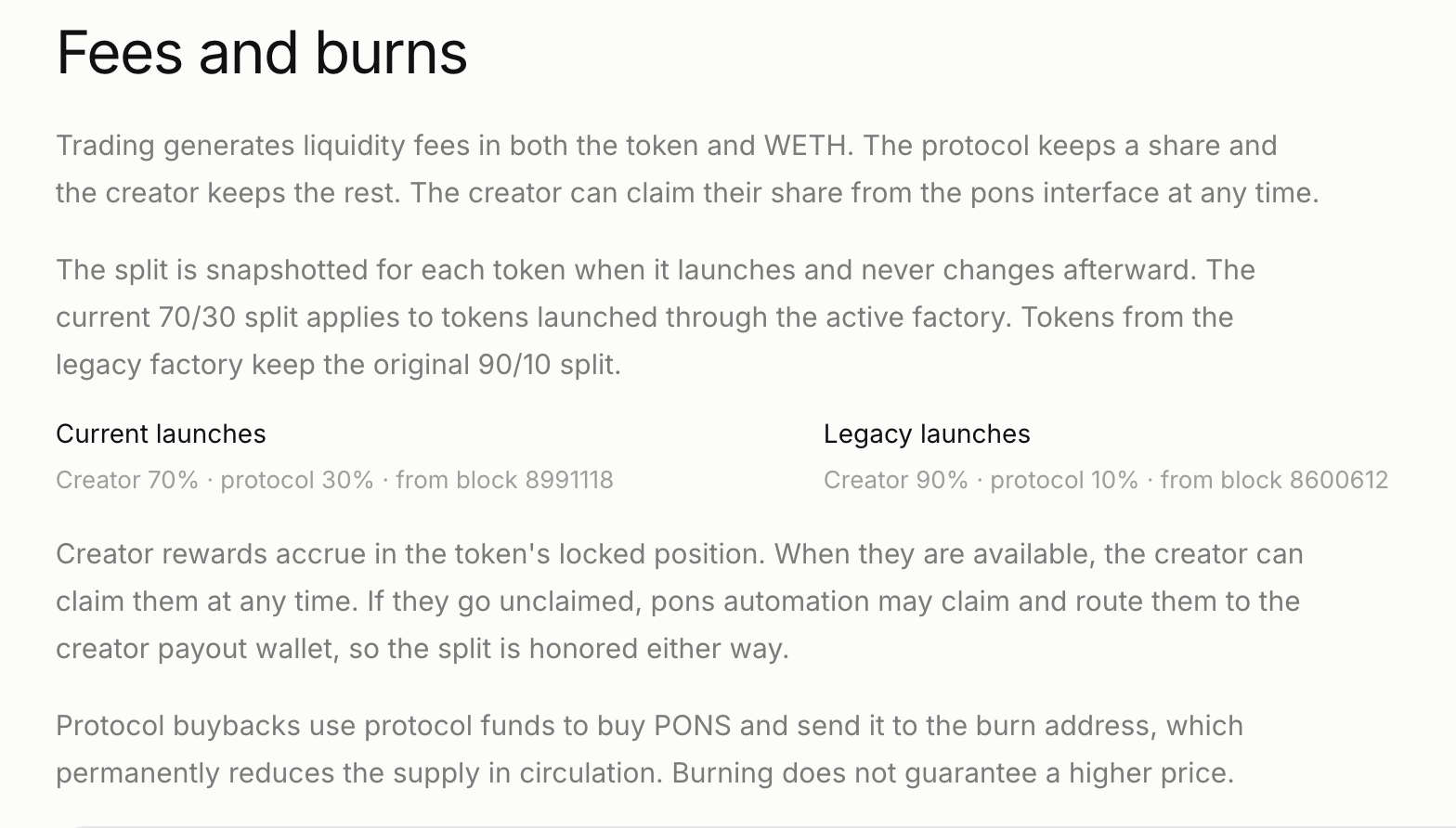
The Protocol revenue section also describes automated TWAP buybacks using 80% of protocol fees and notes that the percentage is not yet immutable. A detailed mechanism makes the process easier to evaluate, but its parameters still need to be checked over time.
HYPE and Four.Meme: distinguish a protocol mechanism from a campaign
Hyperliquid's fee documentation describes fees automatically being converted into HYPE and the HYPE in the Assistance Fund being permanently burned. That is a protocol mechanism, rather than an occasional announcement of a team purchase.
Four.Meme's BNC4 Daily Buyback announcement describes a campaign using product revenue to buy eligible community meme tokens and burn 100% of those purchases. It concerns selected community tokens, rather than a uniform platform-token buyback. It also does not establish that every eligible token will rise in price.
Why can prices still fall after a buyback or burn?
- Expectations may already be priced in. Traders can buy before an announcement and sell after execution.
- Selling can outweigh purchases. Buyback demand may be too small to offset the market's sell orders.
- Repurchased tokens can return to circulation. Treasury holdings, staking rewards, temporary locks and permanent burns have different effects.
- Unlocks and issuance can offset supply reductions. Burn totals need to be assessed alongside emissions, minting permissions and changes in tradable supply.
- Reduced supply cannot replace demand. Continued usage, trading activity and revenue determine whether the mechanism can persist.
What should you verify next?
Start with the official explanation, transaction hashes and the destination or burn instruction. Compare balances, holdings and supply changes before and after execution. A description of a mechanism explains its intended operation; confirming a particular purchase or burn requires its execution records.
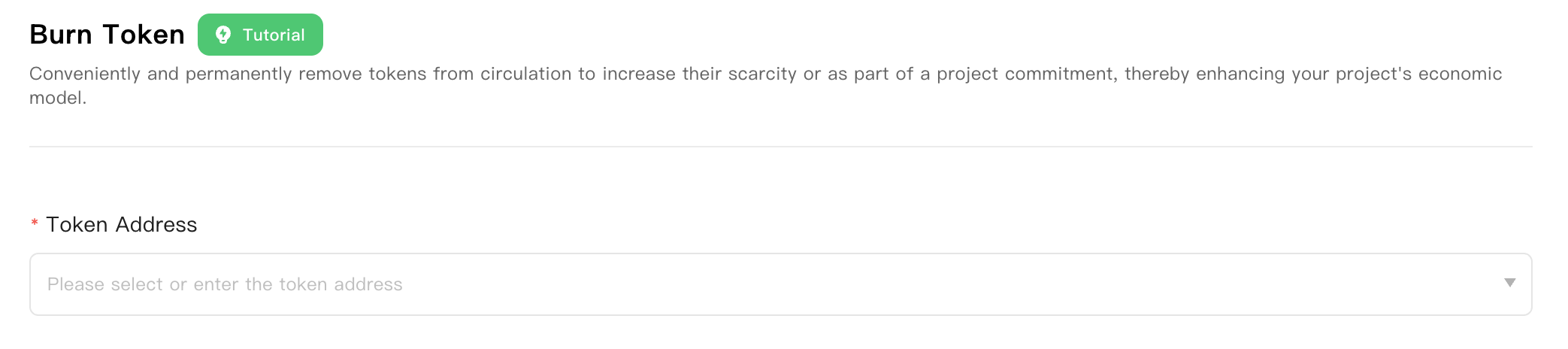
For assets you manage on Solana, SlerfTools Token Burner supports the execution stage once you have confirmed authority, quantities and the burn plan. The token burner documentation covers the steps. SlerfTools does not run project buybacks or make price judgments. Select the appropriate network before using a tool.
Supply reduction is a mechanism, not a price promise
PUMP illustrates an open-market purchase and burn route. STONK shows why direct burns and market buying need separate accounting. ETH demonstrates fee-driven burning, UNI adds a governance and contract path, and PONS makes the purchase-to-burn-address mechanism explicit. HYPE and Four.Meme further show why an ongoing protocol process and a campaign need different evidence.
Before reacting to a buyback-and-burn announcement, check the funding, execution records, net supply changes and demand. Those factors determine whether the deflationary narrative has lasting support.
This article is for news and industry information only. It is not legal, securities, investment, or compliance advice.
About SlerfTools
SlerfTools is a multi-chain Web3 toolkit supporting Solana, BNB Chain (BSC), Base, Ethereum, Robinhood Chain, and other supported EVM-compatible networks. It provides tools for common on-chain workflows, including token management, liquidity management, wallet operations, batch transfers, and batch transaction execution. SlerfTools is designed to help teams work more efficiently while retaining control of wallet access and transaction approvals.