Arc Hit $400M on Day One. Why Did the Hype Fade?
Arc reportedly did $410.8M in first-day DEX volume, with launchpads reportedly accounting for 82%. See why meme liquidity cooled after the livestream.
Arc went live on September 16, 2026. Circle presented it as stablecoin-native infrastructure for payments, foreign exchange, and capital markets, with more than 100 institutional and ecosystem builders live on day one. Circle's mainnet announcement looked like the launch of a serious financial network.
The market narrative changed quickly. After a clip from the launch-day developer pre-show circulated on X, several Arc ecosystem meme tokens sold off sharply. Community posts started describing the whole chain as “dead” or “silent.”
The more defensible conclusion is narrower: there is no evidence that one livestream stopped the Arc network. The livestream appears to have acted as a sentiment trigger, exposing how dependent the first-day activity was on meme launchpads and short-term liquidity.
TL;DR: Arc reportedly recorded about $410.8 million in first-day DEX volume, and the same report said launchpads accounted for roughly 82% of it. That looks more like a concentrated burst of attention and speculative liquidity than proof of durable users. To judge whether Arc is actually cooling, watch repeat addresses, non-meme applications, and USDC settlement activity, not one clip or a few red candles.
What happened on the livestream?
Circle scheduled a launch broadcast for the public-mainnet release, and its official announcement directed viewers to @arc at 2 p.m. Eastern Time. The main program featured Circle CEO Jeremy Allaire, BlackRock, DTCC, Aave, and other ecosystem participants. A developer pre-show highlighted partner projects.
The clip at the center of the controversy came from that pre-show. In its September 17 report, CryptoRank republished a BeInCrypto account identifying the guest as Panchu Vijay Pal, who runs the third-party project XyloNet, not Circle's founder. Some traders treated the guest's appearance and background as a sell signal and posted that they exited after watching the broadcast. The report cited market data showing TOLLY down roughly 68% and ARGUS down roughly 50% at one point.
I just sold everything I had on @arc
— KR (@KR4ATH) September 16, 2026
After seeing this live
Goodnight pic.twitter.com/yxOxrEKhut
Two facts need to stay separate. Treating a person's nationality or appearance as a proxy for project quality is prejudice, not due diligence. But in a thin, crowded meme market, prejudice and emotion can still become the button that triggers a coordinated exit. That says the liquidity was fragile; it does not prove anything about a country or a person's competence.
Why does $400 million not equal durable demand?
The same report put Arc's first-day DEX volume at about $410.8 million and said launchpads generated roughly 82% of it. Using the report's own rounded figures, that would be roughly $337 million associated with launchpad activity. It is still a reported first-day figure, not an audited measure of every economic activity on Arc, and it cannot prove that the livestream caused the entire sell-off.
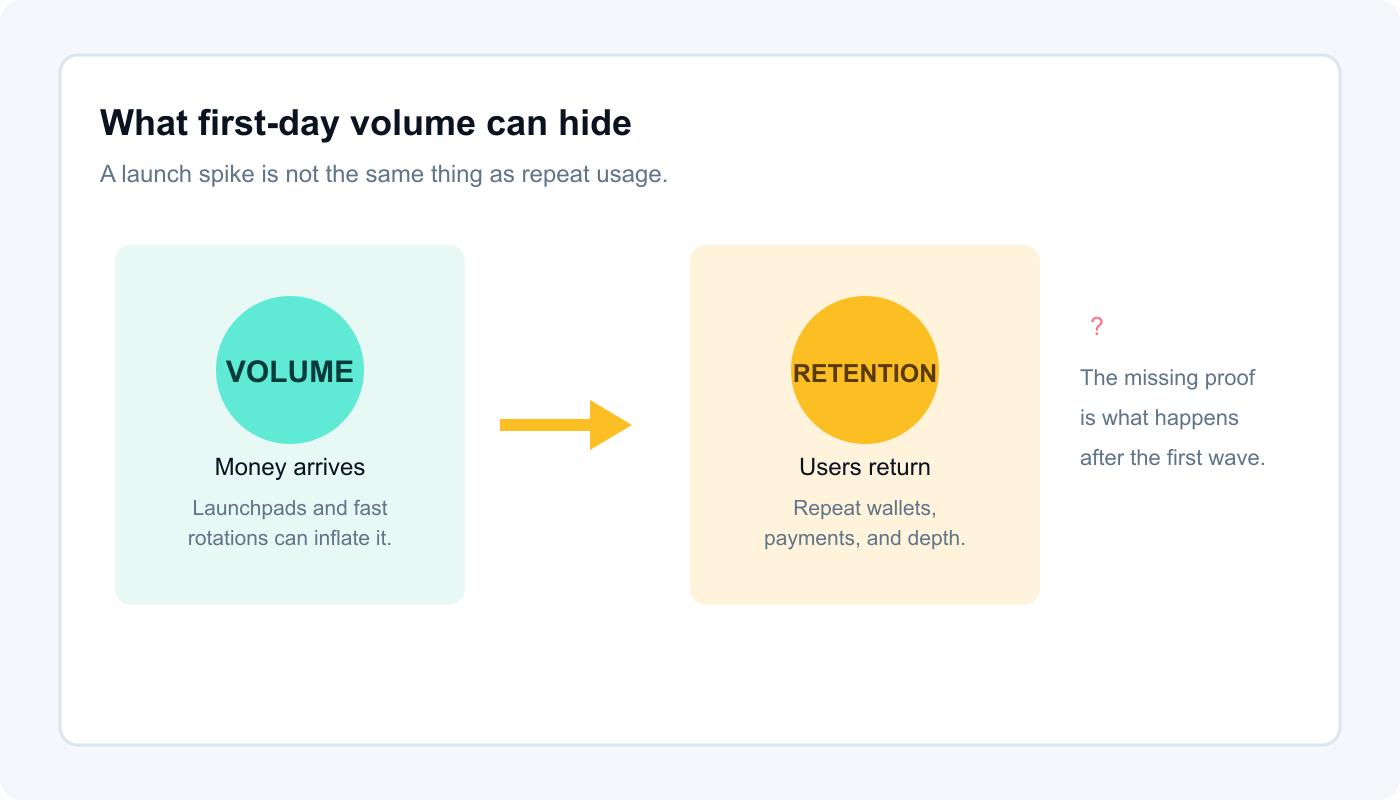
The deeper distinction is simple: first-day volume tells us how much money arrived. It does not tell us how many users stayed.
| What the launch showed | What still needs proof |
|---|---|
| High DEX volume | Repeat active addresses rather than one-time wallets |
| Busy meme launchpads | Sustained use of payments, lending, RWA, and other non-meme apps |
| Heavy X attention | Stable USDC transfers, fee activity, and market depth |
Arc's official positioning is institutional and stablecoin-focused, while its most visible first-day flow came from meme launchpads. Those stories are not mutually exclusive, but they attract different users. Financial infrastructure needs predictability and retention. Meme traders need speed, narrative, and the next buyer. When the second group leaves first, the market can mistake a meme cooldown for a network-wide failure.
Did Arc cool off, or did the meme trade cool off first?
The careful wording is: Arc's first meme wave showed clear signs of cooling, but “the entire chain went silent” has not been proven with like-for-like data. Aggregate first-day DEX volume, the drawdown of individual meme tokens, and later top-token snapshots measure different windows and different things. They should not be stitched into a precise collapse chart.
The more useful watchlist has four items:
- Repeat active addresses: Are the same wallets rotating, or are new users returning?
- Non-meme usage: Do payments, lending, RWA applications, and stablecoin transfers persist?
- Liquidity depth: Can relatively small sells still create extreme slippage?
- Development and fee activity: Do contracts, settlement flows, and fees hold up for weeks rather than hours?
If those signals do not follow the launch-day headline, the first $400 million was closer to opening fireworks than proof of product-market fit. The livestream may have moved attention from the fireworks back to the ledger.
What should ordinary users do now?
Do not declare Arc a failure because a livestream was followed by red candles. Do not treat a large first-day volume number as a reason to buy every Arc meme token either. Separate the Arc network, projects deployed on Arc, and individual tokens. Check utility, liquidity, holder concentration, and on-chain records before treating a social-media narrative as a fact.
If your interest moves from watching the story to managing ordinary tokens, wallets, or batch workflows on a supported network, you can open the SlerfTools Arc toolkit. For network parameters, Chain ID 5042, and USDC gas details, use the Arc Chain Guide. SlerfTools provides common multi-chain execution tools; it does not assess a project's value and is not Circle's or Arc's issuer, broker, custodian, or trading venue.
Conclusion: one livestream did not kill a chain
Blaming Arc's short-term cooling entirely on a livestream is too simple. Treating $400 million of first-day volume as proof of lasting adoption is just as risky.
The episode exposes a familiar attention structure for new chains: memes and launchpads push activity to a peak, then liquidity, product usage, and retention decide whether the attention stays. Arc's next test is not another viral post. It is whether stablecoin and financial activity remains after the meme crowd moves on.
This article is for news and industry information only. It is not legal, securities, investment, or compliance advice.
About SlerfTools
SlerfTools is a multi-chain Web3 toolkit supporting Solana, BNB Chain (BSC), Base, Ethereum, Robinhood Chain, and other supported EVM-compatible networks. It provides tools for common on-chain workflows, including token management, liquidity management, wallet operations, batch transfers, and batch transaction execution. SlerfTools is designed to help teams work more efficiently while retaining control of wallet access and transaction approvals.